
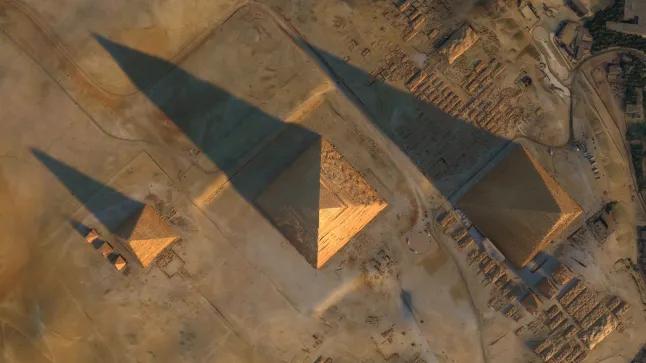

A new theory has suggested that the Great Pyramid of Giza may have been designed to preserve mathematical and astronomical knowledge through its dimensions and proportions.
Independent researcher Sefy Levy argues in a paper published in August that measurements taken from the pyramid’s height, base, sloping sides and overall shape may form a numerical system linked to cycles of the Moon, planets and calendar. Levy’s paper, titled The Pyramid as Memory Hypothesis, has not yet been peer reviewed.
He argues that the pyramid’s dimensions may have been deliberately chosen to preserve knowledge in a form capable of surviving long after its builders. “The pyramid was not built to last forever because it contained something valuable…it was because it was something valuable,” Levy wrote. He added that the pyramid represents “the knowledge…made stone”.

According to the report, Levy reached his conclusions by examining key dimensions of the Great Pyramid and dividing them using fractions known to have been used by ancient Egyptians. One of his calculations produces the figure 27.5, which he says is close to the approximately 27.55-day cycle associated with the Moon reaching its closest point to Earth.
Another figure, 70, is interpreted by Levy as potentially representing the period between the heliacal setting and rising of Sirius, the brightest star visible in Earth’s night sky. He also argues that other calculations produce figures resembling the repeating cycles of planets including Venus and Jupiter.
Levy further claims that the pyramid’s proportions generate values close to mathematical constants such as pi and the golden ratio. These interpretations remain part of Levy’s hypothesis and have not been established as evidence of the pyramid builders’ intentions. His broader theory also draws on ancient Egyptian creation traditions associated with Heliopolis.
According to the creation account referenced by Levy, the world initially consisted of a dark, endless body of water known as Nun before a sacred mound of land, called the benben, emerged. The creator god Atum was then said to have brought himself into existence from the mound.
Levy proposes that the pyramids may have been built as representations of that primordial mound. He has also suggested another possibility: that their shape may have been inspired by a landscape associated with the distant ancestors of ancient Egyptians, which he identifies as the Eye of the Sahara in Mauritania.
The theory proposes that communities may once have lived in the region before environmental conditions changed and water sources diminished, prompting migration east towards the Nile. Levy suggests later generations could have constructed the pyramids partly as a memorial to an ancestral homeland.
The hypothesis is one of several recent attempts to explain both the symbolism and construction of the Great Pyramid, also known as the Pyramid of Khufu. Separate research published earlier this year proposed that the pyramid may have been constructed using a multi-channel system of ramps built into its edges.
That study suggested workers could have used a spiral ramp system that was progressively covered as additional layers of the pyramid were completed. Levy’s claims about encoded astronomical and mathematical knowledge remain speculative pending further scrutiny and peer review.